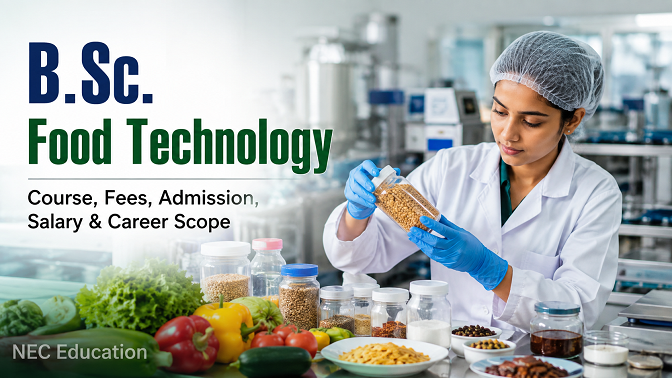
🍎🏭 B.Sc. Food Technology: Fees, Admission, Colleges & Career Scope in India
Bachelor of Science (B.Sc.) in Food Technology is a 3-year undergraduate degree (with some universities offering 4-year Honours/Honours with Research programs under NEP 2020) that focuses on the processing, preservation, packaging, quality control, safety, and production of food products. The course integrates concepts from food science, microbiology, chemistry, nutrition, engineering, and biotechnology to ensure food is safe, nutritious, and meets industry standards.
Students receive practical training through food processing laboratories, microbiological testing, quality analysis, industrial internships, product development, and research projects, preparing them for careers in the rapidly growing food processing and FMCG sectors.
📌 Why Choose B.Sc. Food Technology?
- Growing demand in the food processing and FMCG industries
- Strong career opportunities in Quality Assurance (QA), Quality Control (QC), and Research & Development (R&D)
- Hands-on laboratory and industrial training
- Opportunities in food safety, packaging, and product innovation
- Excellent foundation for higher studies and research
- Careers in government food safety agencies and private industries
- Opportunity to contribute to food quality, nutrition, and public health
🎓 Course Overview
| Feature | Details |
|---|---|
| Course Name | Bachelor of Science (B.Sc.) in Food Technology |
| Course Level | Undergraduate Degree |
| Duration | 3 Years (6 Semesters) or 4 Years (Honours/Research at some universities) |
| Eligibility | 10+2 with Science (PCM, PCB, or PCMB depending on university requirements) |
| Admission | Merit-Based Admission, CUET (for participating universities), University Entrance Exams, or Institution-Specific Admission Process |
| Course Mode | Full-Time |
| Practical Training | Food Processing Labs, Quality Testing, Industrial Internship & Research Projects |
📚 Subjects Covered
Foundation Subjects
- Food Chemistry
- Food Microbiology
- Food Biochemistry
- Human Nutrition
- Biostatistics
- Computer Applications
- Communication Skills
Core Subjects
- Food Processing Technology
- Food Preservation Techniques
- Food Engineering
- Food Packaging Technology
- Dairy Technology
- Fruit & Vegetable Processing
- Cereals and Pulse Technology
- Meat, Poultry & Seafood Technology
- Food Biotechnology
- Food Quality Assurance
- Food Safety & Hygiene
- Food Analysis
- Food Toxicology
- Food Regulations (FSSAI & Codex)
- Sensory Evaluation
- Food Product Development
- Food Supply Chain Management
- Food Waste Management
🛠 Practical Components
- Food Product Development
- Food Microbiology Laboratory
- Food Quality Testing
- Instrumental Analysis
- Packaging Evaluation
- Shelf-Life Studies
- Sensory Evaluation
- HACCP Implementation
- Industrial Internship
- Research Project
🧾 Admission Process
- Complete 10+2 in the Science stream from a recognized board.
- Meet the eligibility criteria of the preferred institution.
- Apply through the university admission portal.
- Qualify through CUET (for participating universities), university entrance examinations, or merit-based admission, depending on the institution.
- Complete counseling, document verification, and fee payment.
📋 Eligibility Criteria
- Passed 10+2 from a recognized board.
- Most universities accept students with PCM, PCB, or PCMB, though subject requirements vary by institution.
- Minimum 50–60% aggregate marks (varies by university and category).
💰 B.Sc. Food Technology Course Fees in India
| Institution Type | Approximate Annual Fees |
|---|---|
| Government Colleges | ₹10,000 – ₹50,000 |
| Government Universities | ₹20,000 – ₹80,000 |
| Private Colleges | ₹50,000 – ₹2 Lakhs |
| Private Universities | ₹1 – ₹3 Lakhs |
Fees vary depending on laboratory facilities, industry exposure, and university infrastructure.
🏫 Top Colleges for B.Sc. Food Technology in India
- National Institute of Food Technology Entrepreneurship and Management (NIFTEM), Haryana
- Institute of Chemical Technology (ICT), Mumbai
- Lovely Professional University (LPU), Punjab
- Sharda University, Greater Noida
- University of Agricultural Sciences (UAS), Bengaluru
- Govind Ballabh Pant University of Agriculture & Technology (GBPUAT), Pantnagar
- Tamil Nadu Agricultural University (TNAU), Coimbatore
- Punjab Agricultural University (PAU), Ludhiana
- University of Calcutta
- Andhra University, Visakhapatnam
🌟 Career Scope After B.Sc. Food Technology
Graduates can work in:
- Food Processing Industries
- FMCG Companies
- Dairy & Beverage Industries
- Bakery & Confectionery Industry
- Nutraceutical Companies
- Food Testing Laboratories
- Quality Assurance & Quality Control Laboratories
- Packaging Industries
- Hospitality & Catering Companies
- Government Food Safety Departments
- Research & Development Organizations
Popular Job Roles
- Food Technologist
- Food Safety Officer
- Quality Control Executive
- Quality Assurance Executive
- Production Supervisor
- Food Analyst
- Food Microbiologist
- Product Development Executive
- Packaging Technologist
- Regulatory Affairs Executive
- Technical Sales Executive
Note: Government positions in organizations such as FSSAI, state food safety departments, and public laboratories are filled through specific recruitment processes and eligibility criteria. Research and academic positions generally require M.Sc., NET, or Ph.D., depending on the role.
💵 Salary After B.Sc. Food Technology
| Job Role | Average Annual Salary |
|---|---|
| Quality Control Executive | ₹3 – ₹5.5 Lakhs |
| Food Analyst | ₹3.5 – ₹6 Lakhs |
| Production Supervisor | ₹4 – ₹7 Lakhs |
| Food Technologist | ₹4 – ₹8 Lakhs |
| Food Safety Officer | ₹4.5 – ₹8 Lakhs |
| Product Development Executive | ₹5 – ₹9 Lakhs |
| Quality Assurance Executive | ₹5 – ₹9 Lakhs |
| Food Scientist (After Higher Studies & Experience) | ₹8 – ₹18 Lakhs+ |
Salary depends on employer, technical skills, location, certifications, and higher qualifications.
🎓 Higher Education & Professional Certifications
Higher Education
- M.Sc. Food Technology
- M.Sc. Food Science & Technology
- M.Sc. Food Microbiology
- M.Sc. Food Chemistry
- M.Sc. Nutrition & Dietetics
- M.Tech. Food Technology (where eligible)
- MBA (Food & Agribusiness)
- Ph.D. in Food Technology
Professional Certifications
- HACCP
- ISO 22000 Food Safety Management Systems
- FSSC 22000
- Good Manufacturing Practices (GMP)
- Good Laboratory Practices (GLP)
- Food Packaging Technology
- Food Quality Management
- Internal Food Safety Auditor
🌍 Career Opportunities Abroad
B.Sc. Food Technology graduates can pursue higher education or careers in:
- United States
- Canada
- United Kingdom
- Australia
- Germany
- Netherlands
- New Zealand
- Ireland
- Singapore
- United Arab Emirates
Career opportunities include food manufacturing, quality assurance, food safety, product development, packaging technology, supply chain management, nutraceuticals, regulatory affairs, and food research. Advanced research and specialist roles generally require postgraduate qualifications.