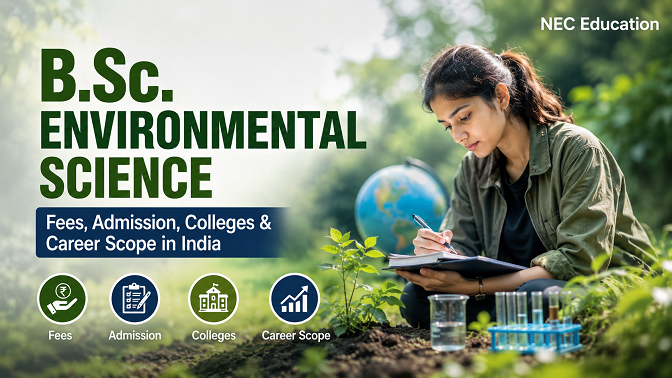
Bachelor of Science (B.Sc.) in Environmental Science is a 3-year undergraduate degree (with some universities offering 4-year Honours/Honours with Research programs under NEP 2020) that focuses on understanding the environment, ecosystems, biodiversity, climate change, pollution control, natural resource management, environmental laws, and sustainable development.
The course combines principles of biology, chemistry, physics, geology, ecology, and environmental engineering to help students understand environmental challenges and develop sustainable solutions. Students gain practical experience through laboratory work, field surveys, environmental impact assessments, GIS applications, and research projects.
B.Sc. Environmental Science graduates can build careers in environmental consulting, pollution control, sustainability, renewable energy, waste management, research, government agencies, NGOs, industries, and international environmental organizations.
📌 Why Choose B.Sc. Environmental Science?
- Study one of the fastest-growing and globally relevant scientific fields
- Contribute to climate action and environmental conservation
- High demand for sustainability and environmental professionals
- Opportunities in government, private industries, NGOs, and research organizations
- Develop expertise in environmental monitoring and pollution control
- Excellent foundation for higher studies and environmental research
- Build multidisciplinary scientific and analytical skills
🎓 Course Overview
| Feature | Details |
|---|---|
| Course Name | Bachelor of Science (B.Sc.) in Environmental Science |
| Course Level | Undergraduate Degree |
| Duration | 3 Years (6 Semesters) or 4 Years (Honours/Research at some universities) |
| Eligibility | 10+2 with Science stream from a recognized board (PCB/PCM/PCMB, depending on the institution) |
| Admission | Merit-Based Admission, CUET (for participating universities), University Entrance Exams, or Institution-Specific Admission Process |
| Course Mode | Full-Time |
| Practical Training | Environmental Laboratories, Field Surveys, GIS, Environmental Monitoring & Research Projects |
📚 Subjects Covered
Foundation Subjects
- Environmental Biology
- Environmental Chemistry
- Environmental Physics
- Earth Science
- Ecology
- Environmental Statistics
- Scientific Communication
Core Subjects
- Environmental Pollution
- Air, Water & Soil Pollution
- Biodiversity Conservation
- Climate Change
- Ecosystem Ecology
- Environmental Toxicology
- Waste Management
- Renewable Energy
- Natural Resource Management
- Environmental Biotechnology
- GIS & Remote Sensing
- Environmental Impact Assessment (EIA)
- Environmental Laws & Policies
- Disaster Management
- Hydrology
- Sustainable Development
- Wildlife Conservation
- Urban Environmental Management
- Green Technologies
🛠 Practical Components
- Water Quality Analysis
- Soil Testing
- Air Pollution Monitoring
- Environmental Sampling
- Biodiversity Surveys
- GIS & Remote Sensing Applications
- Environmental Impact Assessment Studies
- Waste Management Projects
- Industrial & Field Visits
- Research Project / Mini Dissertation
🧾 Admission Process
- Complete 10+2 in the Science stream from a recognized board.
- Meet the eligibility requirements of the preferred institution.
- Apply through the university admission portal.
- Qualify through CUET (for participating universities), university entrance examinations, or merit-based admission, depending on the institution.
- Complete counseling, document verification, and fee payment.
📋 Eligibility Criteria
- Passed 10+2 from a recognized board.
- Most universities accept students with PCB, PCM, or PCMB backgrounds.
- Minimum 50–60% aggregate marks (varies by institution and category).
💰 B.Sc. Environmental Science Course Fees in India
| Institution Type | Approximate Annual Fees |
|---|---|
| Government Colleges | ₹5,000 – ₹35,000 |
| Government Universities | ₹10,000 – ₹60,000 |
| Private Colleges | ₹40,000 – ₹1.8 Lakhs |
| Private Universities | ₹80,000 – ₹3 Lakhs |
Fees vary depending on laboratory facilities, fieldwork, and university infrastructure.
🏫 Top Colleges for B.Sc. Environmental Science in India
- University of Delhi
- Banaras Hindu University (BHU), Varanasi
- Jawaharlal Nehru University (JNU), New Delhi (primarily postgraduate; related environmental programs)
- Christ (Deemed to be University), Bengaluru
- Amity University
- Lovely Professional University (LPU)
- University of Calcutta
- Fergusson College, Pune
- Madras Christian College (MCC), Chennai
- Aligarh Muslim University (AMU)
🌟 Career Scope After B.Sc. Environmental Science
Graduates can work in:
- Environmental Consulting Firms
- Pollution Control Boards
- Renewable Energy Companies
- Waste Management Companies
- Water Treatment Plants
- Research Institutions
- NGOs
- Environmental Laboratories
- Mining & Infrastructure Companies
- Manufacturing Industries
- Government Departments
- International Environmental Organizations
Popular Job Roles
- Environmental Scientist
- Environmental Consultant
- Sustainability Executive
- Environmental Analyst
- Pollution Control Officer
- Waste Management Executive
- Environmental Health & Safety (EHS) Officer
- Research Assistant
- GIS Analyst
- Water Quality Analyst
- Climate Change Associate
Note: Many scientific positions in organizations such as the Central Pollution Control Board (CPCB), State Pollution Control Boards, CSIR, NEERI, and other government research institutions require M.Sc., relevant recruitment examinations, or higher qualifications depending on the role.
💵 Salary After B.Sc. Environmental Science
| Job Role | Average Annual Salary |
|---|---|
| Environmental Analyst | ₹3 – ₹6 Lakhs |
| Research Assistant | ₹3.5 – ₹6 Lakhs |
| EHS Officer | ₹4 – ₹8 Lakhs |
| GIS Analyst | ₹4 – ₹8 Lakhs |
| Sustainability Executive | ₹5 – ₹9 Lakhs |
| Environmental Consultant | ₹5 – ₹10 Lakhs |
| Pollution Control Officer | ₹5 – ₹9 Lakhs |
| Environmental Scientist (After Higher Studies & Experience) | ₹8 – ₹18 Lakhs+ |
Salary depends on qualifications, employer, technical skills, certifications, location, and experience.
🎓 Higher Education & Professional Certifications
Higher Education
- M.Sc. Environmental Science
- M.Sc. Ecology
- M.Sc. Environmental Management
- M.Sc. Climate Science
- M.Sc. Wildlife Science
- M.Sc. Forestry
- M.Tech. Environmental Engineering (subject to eligibility)
- MBA (Sustainability Management)
- Ph.D. in Environmental Science
Professional Certifications
- Environmental Impact Assessment (EIA)
- GIS & Remote Sensing
- ISO 14001 Environmental Management Systems
- Occupational Health, Safety & Environment (HSE)
- Carbon Footprint & ESG Reporting
- Waste Management
- Water & Wastewater Treatment
- Sustainability & Green Building
🌍 Career Opportunities Abroad
B.Sc. Environmental Science graduates can pursue higher education or careers in:
- United States
- Canada
- United Kingdom
- Australia
- Germany
- Netherlands
- Sweden
- New Zealand
- Singapore
- Norway
Career opportunities include environmental consulting, sustainability, climate change research, renewable energy, biodiversity conservation, ESG reporting, environmental policy, pollution control, and ecological restoration. Many advanced research and policy roles require postgraduate qualifications.